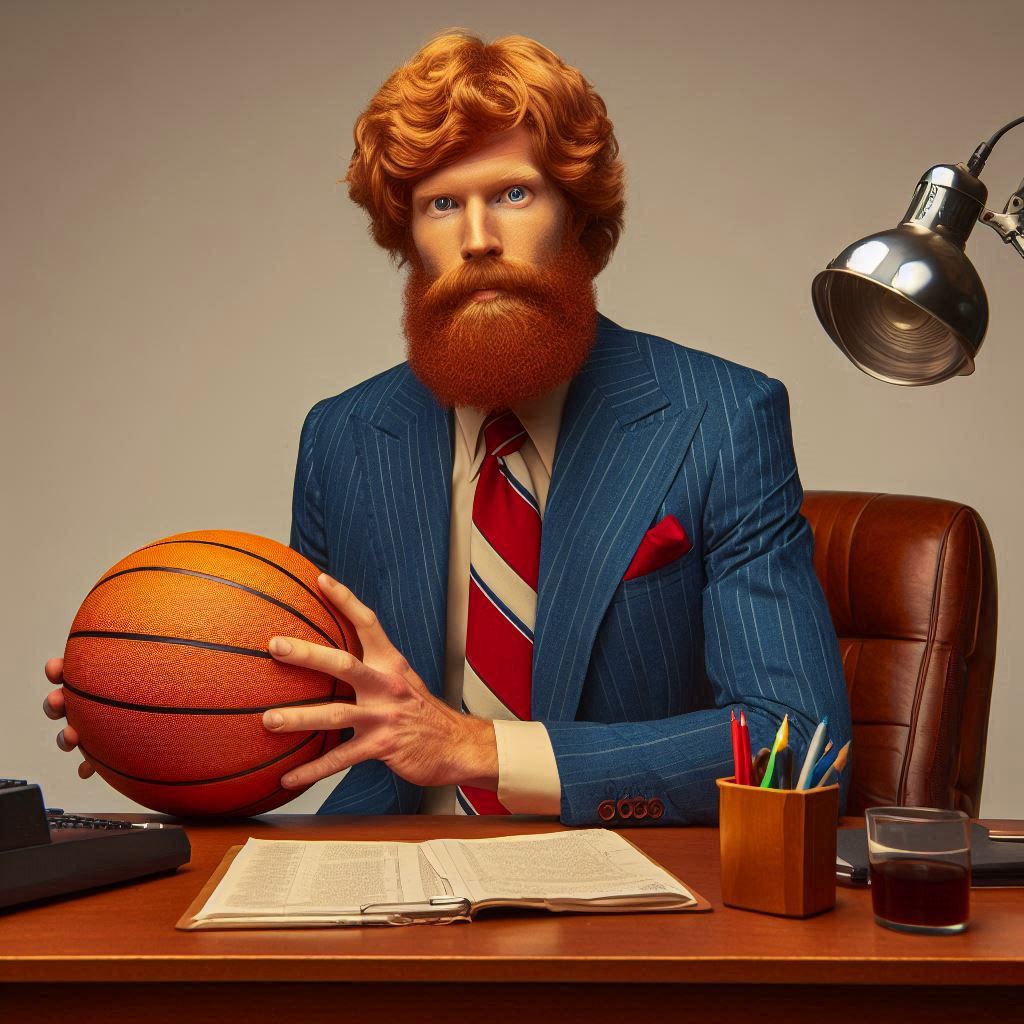
For my fictional therapist Dr Walton, I am always trying to come up with some unconventional ideas for him. Originally he met a couple for marriage counseling on the roof of the office where there was a basketball half court; he spent the session playing one-on-one against the husband while putting the wife to the sideline. In another, the husband’s mistress was invited to the couple’s session with the women competing to prove who knew the husband more in a Newlywed Game scenario.
I was thinking about Dr Walton having BOB (the Body Opponent Bag) in his marriage counseling office. When a husband is to overcome with emotions to verbalize during a session Dr Walton would offer the husband BOB to communicate with kinesthetically. BOB would wear a wig matching the color of the wife’s hair.
** Copilot Reply**
That’s a perfectly Walton idea — it fits his ethos, his theatrical bluntness, and his belief that emotional honesty often needs a physical catalyst rather than another polite conversational prompt.
And BOB in that office wouldn’t be a gimmick. It would be a tool of disclosure, a kinetic surrogate for the wife when the husband’s verbal bandwidth collapses under shame, anger, or fear. The wig is the detail that makes it Waltonian: slightly unsettling, slightly humorous, and absolutely purposeful.
—
🧩 Why BOB works in Walton’s therapeutic universe
Walton’s entire method is built around disrupting the patient’s defensive equilibrium. He doesn’t wait for self‑judgment; he provokes it. He uses confrontation not to punish but to unstick the psyche.
BOB fits that philosophy because:
– Kinesthetic expression bypasses the husband’s verbal choke points.
– Externalizing emotion lets Walton observe the real affect instead of the socially edited version.
– Embodied communication reveals patterns: hesitation, aggression, avoidance, tenderness.
– Projection onto a surrogate gives Walton a diagnostic window into the marriage dynamic.
BOB becomes a mirror, not a target.
—
🧠 How Walton would actually use BOB
Walton wouldn’t say, “Here, hit this.”
He’d say something like:
> “You’re too wound up to talk. So show me.
> Tell her what you can’t say — with your body.”
He’d watch:
– Does the husband square up aggressively?
– Does he collapse inward and hug the dummy?
– Does he talk to it?
– Does he avoid eye contact with the wig?
– Does he strike, then immediately apologize to the dummy?
Walton interprets behavioral truth, not verbal performance.
—
🎭 The wig detail — psychologically sharp
The wig isn’t a joke. It’s a controlled trigger.
It forces the husband to confront the actual relational object (his wife) rather than a neutral training dummy. It makes the exercise emotionally loaded, which is exactly what Walton wants.
It also lets Walton test:
– Transference — does he soften because it “looks like her”?
– Resentment — does he stiffen or lash out?
– Avoidance — does he refuse to engage with the wig at all?
Walton is always looking for the unfiltered truth.
—
🛋️ How this shapes the scene in your story
BOB in Walton’s office instantly tells the reader:
– This therapist is unconventional.
– He values truth over comfort.
– He uses physicality as a diagnostic tool.
– He is not afraid to break norms if it helps the children downstream.
It also gives you a recurring prop — a visual anchor — that can evolve across stories.
—
🔧 If you want, I can help you:
– Build a full scene where Walton introduces BOB.
– Develop Walton’s internal monologue about why he uses it.
– Create a therapeutic protocol he invented around kinesthetic disclosure.
– Write a husband’s emotional breakthrough using BOB.
Which direction do you want to explore next?



Leave a Reply